Beer bottles require precise manufacturing to guarantee safety, stability, and performance during filling and distribution. Beer bottles are particularly sensitive to deviations in verticality, as even minor misalignments can affect the efficiency of automated filling lines and compromise packaging integrity. To address these challenges, the pullon kohtisuoruuden testauslaite has become a standard instrument in quality control laboratories.
Understanding Beer Bottles Perpendicularity Testing
Perpendicularity testing measures the alignment of a bottle’s vertical axis relative to a theoretical straight line from the base to the top finish. Deviations in verticality can result from irregularities in the base, eccentric neck finishes, or ovality of the bottle body. These deviations may cause bottles to lean, jam in filling machines, or stack improperly. Using a perpendicularity checking instrument, manufacturers can detect these defects early in the production process.
ISO 9008 and Industry Standards
The ISO 9008 standard provides a detailed methodology for evaluating verticality and tolerances in glass containers. According to ISO 9008, verticality is defined as the horizontal deviation of a bottle’s central axis from a theoretical vertical line. The standard specifies measurement procedures for both round and non-round bottles, ensuring consistency and reliability in quality assessments. Adhering to ISO 9008 enables breweries and bottle manufacturers to maintain compliance with international quality standards and reduce production errors.
Practical Perpendicularity Testing of Beer Bottles
To perform the perpendicularity test, bottles are placed either on a horizontal baseplate or in a self-centering chuck for non-round designs. The eccentricity tester rotates the bottle or plate 360°, recording the minimum and maximum distances of the bottle’s finish from a reference point. These measurements help calculate the deviation from verticality and identify areas of concern. The results are analyzed to determine whether the bottle meets the prescribed tolerance limits. Consistent testing ensures that all bottles in a production batch conform to quality standards. Additionally, the testing process can identify subtle manufacturing trends that may affect production efficiency over time.
Importance of Beer Bottles Perpendicularity Testing
The impact of verticality on production lines cannot be overstated. Bottles with improper perpendicularity may cause stoppages, misalignment with capping machines, or unstable stacking during storage and transportation. By integrating perpendicularity testing into routine quality checks, manufacturers reduce the risk of operational issues, improve packaging reliability, and enhance customer satisfaction. This test is particularly important for high-speed filling lines where even minor deviations can lead to significant downtime.
Benefits of Using a Bottle Perpendicularity Tester
Using a pullon kohtisuoruuden testauslaite provides several key advantages:
- Accuracy and Reliability: The instrument provides precise measurements of verticality and eccentricity.
- Efficiency: Quick testing minimizes production downtime and allows real-time quality assessment.
- Data Documentation: Test results can be recorded and analyzed for trends, facilitating process improvements.
- Compliance Assurance: Aligns production with ISO 9008 and internal quality guidelines.
- Problem Prevention: Early detection of defects prevents faulty bottles from reaching the market.
- Process Optimization: Long-term data helps refine molding and forming processes for consistent quality.
Cell Instruments PER-01 Verticality Tester
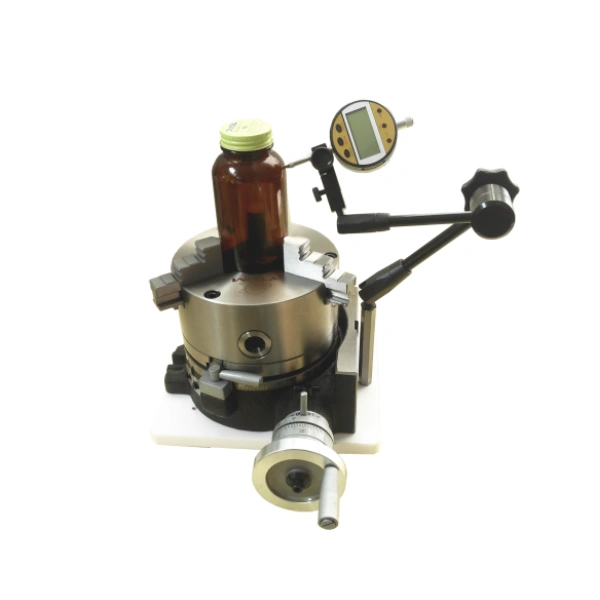
For breweries and bottling plants, the Cell Instruments PER-01 Verticality Tester is a robust solution. It accommodates various bottle sizes, including round and non-round designs, and provides accurate readings of deviations down to 0.1 mm. Its ergonomic design ensures easy operation and seamless integration into existing quality control workflows. By adopting the PER-01, production teams can enhance manufacturing precision and maintain high-quality standards consistently.
Conclusion
Beer bottles require meticulous quality control to ensure their verticality, prevent operational disruptions, and maintain product integrity. Through the use of bottle perpendicularity testers and compliance with ISO 9008, manufacturers can identify deviations in vertical alignment, reduce waste, and improve overall production efficiency. Integrating these tests into routine inspection protocols not only guarantees compliance but also strengthens brand reputation. Proper perpendicularity testing ensures that every bottle delivered is safe, stable, and ready for the rigorous demands of filling, packaging, and transportation. Furthermore, consistent testing and data tracking help manufacturers proactively adjust production parameters, achieving higher yield and reduced material waste.
 FI
FI  EN
EN  AR
AR  BG
BG  CS
CS  DA
DA  DE
DE  EL
EL  ES
ES  ET
ET  FR
FR  HU
HU  ID
ID  IT
IT  JA
JA  KO
KO  LT
LT  LV
LV  NB
NB  NL
NL  PL
PL  PT
PT  RO
RO  RU
RU  SK
SK  SL
SL  SV
SV  TR
TR  UK
UK