Importance of Verticality of Beverage Bottles in Production
Maintaining consistent verticality of beverage bottles is essential for beverage manufacturers. Improperly aligned bottles can lead to filling line inefficiencies, capping errors, packaging instability, and even customer dissatisfaction. The deviation of a beverage bottle’s vertical axis, known as eccentricity, affects automated equipment performance.
Beyond production efficiency, verticality also influences packaging aesthetics and shelf presentation. Bottles leaning in cartons or on shelves reduce perceived quality, potentially affecting brand reputation. Therefore, routine checks of verticality using an eccentricity tester are critical for both operational and commercial success. Regular monitoring helps identify trends in mold wear or cooling inconsistencies early, preventing widespread defects.
Using an Eccentricity Tester for Beverage Bottles
An eccentricity tester is designed to determine the horizontal deviation of a beverage bottle’s central axis from its theoretical vertical line. This equipment is particularly useful for detecting:
- Ovality of the bottle base
- Offset or misaligned finishes
- Body deformation or irregularities
The Tester prostopadłości butelek ensures accurate measurement by rotating the bottle 360° and recording maximum and minimum deviations. Precision readings allow manufacturers to maintain bottles within specified verticality tolerances, as defined in ISO 9008.
ISO 9008 Standard for Verticality
The ISO 9008 standard provides a framework for testing the verticality of beverage bottles. Key points include:
- Measuring horizontal deviation from the ideal vertical axis
- Establishing verticality tolerance limits for both round and non-round bottles
- Ensuring reproducible results for production and quality control
Compliance with ISO 9008 is essential for global beverage production, particularly for companies aiming to maintain high-quality standards across different markets.
Step-by-Step Procedure for Verticality Testing
Round Beverage Bottles
- Place the beverage bottle on a horizontal baseplate and press it against a V-block at a 45° angle.
- Alternatively, secure the bottle on a rotating plate with a three- or four-jaw self-centering chuck.
Non-Round Beverage Bottles
- Position the bottle carefully in a device designed for irregular shapes.
- Ensure the bottle is stable to prevent skewed measurements.
Measurement Process
- Rotate the beverage bottle through 360° and record minimum and maximum distances from the finish to a fixed horizontal reference point.
- Calculate eccentricity as the difference between these extremes, ensuring results fall within ISO 9008 tolerance limits.
- Repeat measurements on multiple bottles to establish production consistency and detect anomalies before large-scale distribution.
Applications and Benefits of Beverage Bottle Eccentricity Testing
Routine testing provides numerous advantages:
- Optimized filling line efficiency: Upright bottles reduce spillage and machine stoppages.
- Accurate capping: Proper alignment ensures consistent sealing, especially critical for carbonated drinks.
- Improved packaging stability: Bottles fit securely in cartons, pallets, and retail displays.
- Data-driven process improvement: Helps adjust mold design, cooling, and production parameters to reduce defects.
- Enhanced consumer confidence: Consistently upright bottles reflect high quality, strengthening brand reliability.
Recommended Equipment: Cell Instruments Beverage Bottle Perpendicularity Tester
The Cell Instruments PER-01 beverage bottle perpendicularity tester provides a complete solution for accurate measurement and quality control of beverage bottles:
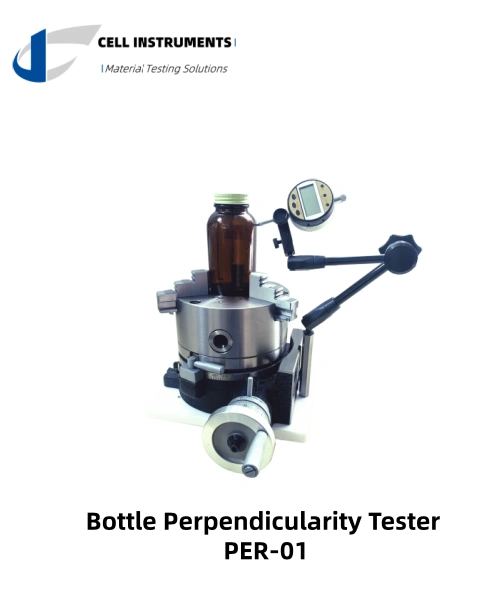
- High-precision measurement – ensures verticality accuracy up to 0.1 mm for reliable inspection.
- Supports round and non-round bottles – versatile design accommodates various bottle shapes on the production line.
- Automated rotation – allows faster and repeatable measurements, reducing manual intervention and improving workflow efficiency.
- ISO 9008 compliant – meets international standards for bottle verticality testing, ensuring globally recognized quality benchmarks.
- Real-time monitoring – enables quality control teams to detect deviations early, preventing filling or capping issues.
- Enhanced production reliability – consistent verticality measurement improves overall packaging performance and minimizes rejection rates.
Conclusion
Ensuring the verticality of beverage bottles with an eccentricity tester is essential for reliable production, accurate capping, and stable packaging. By following ISO 9008 standards, manufacturers can minimize defects, optimize line efficiency, and maintain high-quality presentation for their products. Integrating the Cell Instruments bottle perpendicularity tester into your quality control process provides actionable data to improve operations, enhance product consistency, and ensure consumer satisfaction across the supply chain. Maintaining verticality consistently helps avoid costly returns and supports long-term operational excellence. Regular eccentricity testing of beverage bottles also ensures compliance with industry quality standards and reduces potential production losses.
 PL
PL  EN
EN  AR
AR  BG
BG  CS
CS  DA
DA  DE
DE  EL
EL  ES
ES  ET
ET  FI
FI  FR
FR  HU
HU  ID
ID  IT
IT  JA
JA  KO
KO  LT
LT  LV
LV  NB
NB  NL
NL  PT
PT  RO
RO  RU
RU  SK
SK  SL
SL  SV
SV  TR
TR  UK
UK